Beyond “Fan First”: The Data Plan and the Operational Gap in Sports Digital Strategy
Feb 3, 2024
Reading Time: 3 min
1.
Introduction
In sport and live entertainment, the ambition is consistent: be “fan first,” build a “single fan view,” and deliver more personalised experiences. The gap isn’t a lack of intent — it’s the practical work of collecting, connecting, and using user data in a way that produces measurable outcomes.
Most organisations don’t need more terminology or more tools. They need a buildable operating approach — and in many cases, the missing foundation is a clear data plan that guides what to capture, where it comes from, and how it becomes usable.
1.
Introduction
In sport and live entertainment, the ambition is consistent: be “fan first,” build a “single fan view,” and deliver more personalised experiences. The gap isn’t a lack of intent — it’s the practical work of collecting, connecting, and using user data in a way that produces measurable outcomes.
Most organisations don’t need more terminology or more tools. They need a buildable operating approach — and in many cases, the missing foundation is a clear data plan that guides what to capture, where it comes from, and how it becomes usable.
2.
What “Fan First” Really Means in Practice
“Fan first” is best understood as an operational outcome.
In practice, it means being clear on:
who your users are (fans, audiences, customers)
what data you can realistically capture about them
how that data will be used to improve experience over time
That’s straightforward in principle. The complexity is in execution — not just technically, but commercially and operationally too. Every touchpoint (web, app, content, commerce, in-venue) creates signals. The goal isn’t to collect everything; it’s to collect what’s meaningful for your objectives and make it usable across the ecosystem.
When this goes wrong, data fragments into silos and experience doesn’t improve — and many teams default to producing more content to meet internal expectations. Visibility may hold (social/SEO), but activity becomes noise rather than a lever.
2.
What “Fan First” Really Means in Practice
“Fan first” is best understood as an operational outcome.
In practice, it means being clear on:
who your users are (fans, audiences, customers)
what data you can realistically capture about them
how that data will be used to improve experience over time
That’s straightforward in principle. The complexity is in execution — not just technically, but commercially and operationally too. Every touchpoint (web, app, content, commerce, in-venue) creates signals. The goal isn’t to collect everything; it’s to collect what’s meaningful for your objectives and make it usable across the ecosystem.
When this goes wrong, data fragments into silos and experience doesn’t improve — and many teams default to producing more content to meet internal expectations. Visibility may hold (social/SEO), but activity becomes noise rather than a lever.
3.
Data Plan (Guided by an Ecosystem Map)
Clear objectives and KPIs are table stakes. The differentiator is translating that intent into an operational blueprint.
A pragmatic approach starts with two things:
1) An ecosystem map (current state)
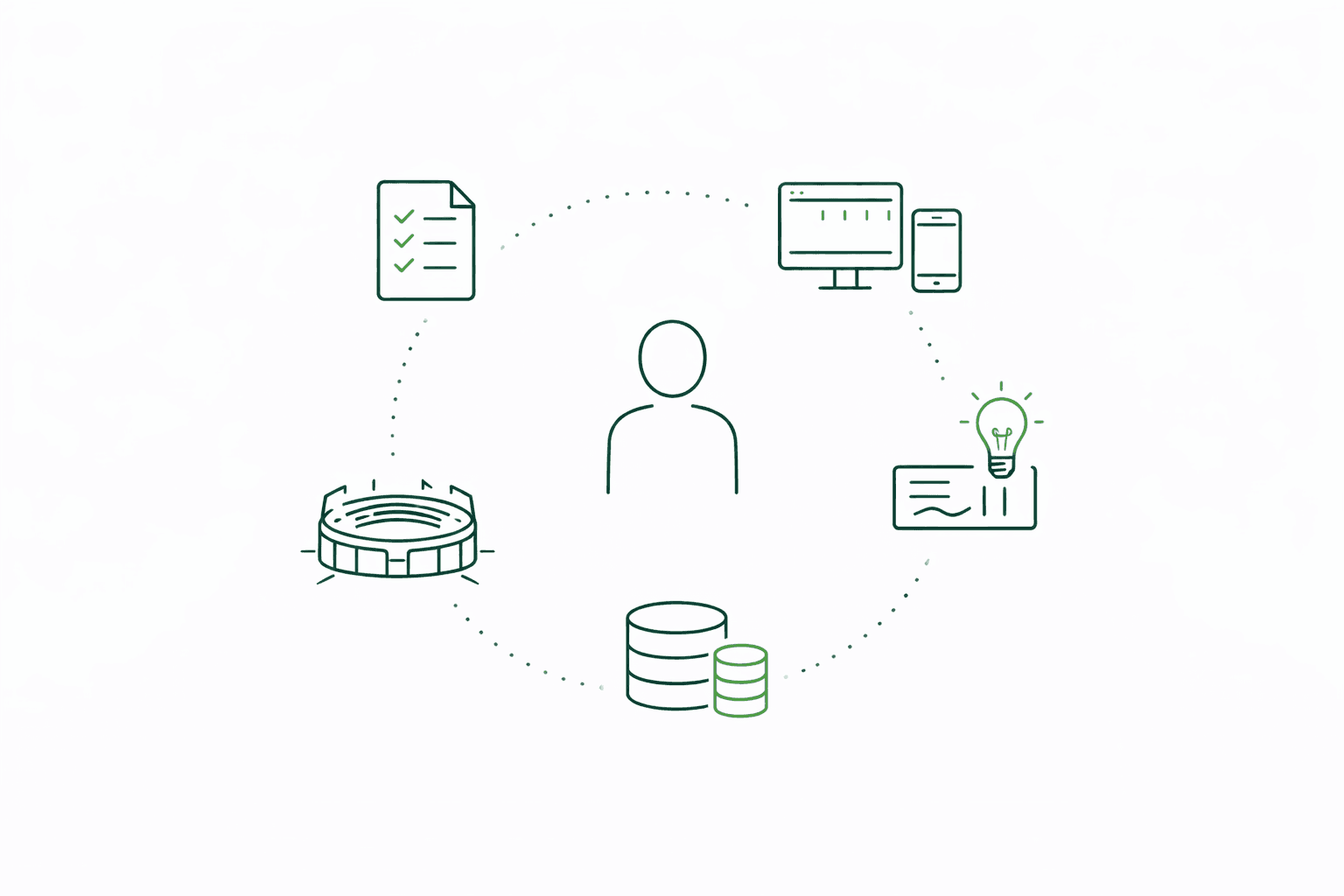
A high-level view of your platforms and channels (ticketing, CRM, app, web, email, analytics, venue systems) and how data does — or doesn’t — move between them.
2) A data plan (what you need, and what’s feasible)
A data plan turns ambition into something implementable. It should answer:
What data points matter most for the experiences you want to deliver?
Where can those signals realistically be captured?
What identifiers will link them (email, membership ID, device ID, etc.)?
Where will the connected dataset live (CRM, CDP, data warehouse — ideally one home)?
How will insights be activated back into channels?
This is where many programmes stumble: ecosystems get built before the data plan is clear, leading to “platform soup” that solves local problems but never creates a connected user view.
3.
Data Plan (Guided by an Ecosystem Map)
Clear objectives and KPIs are table stakes. The differentiator is translating that intent into an operational blueprint.
A pragmatic approach starts with two things:
1) An ecosystem map (current state)
A high-level view of your platforms and channels (ticketing, CRM, app, web, email, analytics, venue systems) and how data does — or doesn’t — move between them.
2) A data plan (what you need, and what’s feasible)
A data plan turns ambition into something implementable. It should answer:
What data points matter most for the experiences you want to deliver?
Where can those signals realistically be captured?
What identifiers will link them (email, membership ID, device ID, etc.)?
Where will the connected dataset live (CRM, CDP, data warehouse — ideally one home)?
How will insights be activated back into channels?
This is where many programmes stumble: ecosystems get built before the data plan is clear, leading to “platform soup” that solves local problems but never creates a connected user view.
4.
Collect, Connect, Treat, Use
Once the plan is clear, delivery becomes a practical workflow:
Instrument the sources
Ensure key touchpoints can actually capture the planned signals consistently (tracking, consent, event capture).Integrate into a central environment
Move data into a unified platform (CRM/CDP/warehouse) using the right mix of APIs, batch feeds, or event streaming.Treat and unify the data
Standardise fields, resolve identities, handle duplicates, apply governance. Weak treatment = weak insight.Activate outcomes
Use insight to drive actions users can feel: better messaging, smarter journeys, improved service, more relevant content, clearer conversion pathways.
4.
Collect, Connect, Treat, Use
Once the plan is clear, delivery becomes a practical workflow:
Instrument the sources
Ensure key touchpoints can actually capture the planned signals consistently (tracking, consent, event capture).Integrate into a central environment
Move data into a unified platform (CRM/CDP/warehouse) using the right mix of APIs, batch feeds, or event streaming.Treat and unify the data
Standardise fields, resolve identities, handle duplicates, apply governance. Weak treatment = weak insight.Activate outcomes
Use insight to drive actions users can feel: better messaging, smarter journeys, improved service, more relevant content, clearer conversion pathways.
5.
When You Can’t Get All the Data
Even with a strong data plan, some data may not be available — and this is especially common in sport.
A practical example is ticketing data. In international federation environments, it’s often owned by the tournament organiser. Even though ticketing is one of the richest data sources, it can be difficult (or impossible) to integrate into a data pipeline due to ownership, compliance constraints, data sharing policies, and commercial realities.
Two important points follow:
Limitations should be designed for — not ignored. A data plan should include what’s ideal and what’s realistically accessible.
“Missing data” doesn’t mean “no progress.” You can still build a meaningful user view using the sources you control (web/app behaviour, CRM records, email engagement, content consumption, in-venue interactions, customer service touchpoints).
Where high-value data is locked behind ownership constraints, the route forward is rarely technical alone. It often requires commercial discussions, partnership structures, and clear data-sharing agreements. The key is not getting stuck waiting for perfect access — it’s continuing to build momentum while creating a pathway to unlock richer sources over time.
5.
When You Can’t Get All the Data
Even with a strong data plan, some data may not be available — and this is especially common in sport.
A practical example is ticketing data. In international federation environments, it’s often owned by the tournament organiser. Even though ticketing is one of the richest data sources, it can be difficult (or impossible) to integrate into a data pipeline due to ownership, compliance constraints, data sharing policies, and commercial realities.
Two important points follow:
Limitations should be designed for — not ignored. A data plan should include what’s ideal and what’s realistically accessible.
“Missing data” doesn’t mean “no progress.” You can still build a meaningful user view using the sources you control (web/app behaviour, CRM records, email engagement, content consumption, in-venue interactions, customer service touchpoints).
Where high-value data is locked behind ownership constraints, the route forward is rarely technical alone. It often requires commercial discussions, partnership structures, and clear data-sharing agreements. The key is not getting stuck waiting for perfect access — it’s continuing to build momentum while creating a pathway to unlock richer sources over time.
6.
Where AI Fits (and Where It Doesn’t)
AI is stage-dependent. Once data is connected, treated, and governed, AI can accelerate:
insight discovery and pattern detection
segmentation and prediction
decision support and recommendation generation
But without the foundations, AI tends to automate fragmentation — producing insights from silos and reinforcing gaps. Introduced at the right moment, it’s an accelerator. Introduced too early, it becomes distraction.
6.
Where AI Fits (and Where It Doesn’t)
AI is stage-dependent. Once data is connected, treated, and governed, AI can accelerate:
insight discovery and pattern detection
segmentation and prediction
decision support and recommendation generation
But without the foundations, AI tends to automate fragmentation — producing insights from silos and reinforcing gaps. Introduced at the right moment, it’s an accelerator. Introduced too early, it becomes distraction.
7.
Conclusion
“Fan first” isn’t achieved through better language or more platforms. It’s achieved through operational discipline: a clear ecosystem map, a pragmatic data plan, and the capability to collect, connect, treat, and activate user data in a way that delivers outcomes.
If you’re tackling this challenge and want a practical starting point, get in touch — we’re happy to share a data plan template and talk through how it applies to your ecosystem and constraints.
7.
Conclusion
“Fan first” isn’t achieved through better language or more platforms. It’s achieved through operational discipline: a clear ecosystem map, a pragmatic data plan, and the capability to collect, connect, treat, and activate user data in a way that delivers outcomes.
If you’re tackling this challenge and want a practical starting point, get in touch — we’re happy to share a data plan template and talk through how it applies to your ecosystem and constraints.
Discover Our
Latest
Blog.

Chat With
Us
Connect with our team instantly to discuss your project needs.
Connect with our team instantly to discuss your project needs.
You're in good company.