Beyond the Game: How Automation Is Transforming
Feb 3, 2024
Reading Time: 3 min
1.
Introduction
Sports and live entertainment operations run on moving parts: last-minute schedule changes, venue constraints, approvals, staffing, travel, accreditation, supplier updates, finance processes, and constant coordination across teams and partners. The work gets done — but too often through manual effort, spreadsheets, inboxes, and “tribal knowledge”.
Automation is increasingly the difference between organisations that cope and organisations that scale. Not because automation is fashionable, but because it reduces operational friction and creates the conditions for broader digital business transformation.
This article looks at what automation actually means in practice, how to approach it sensibly, and how it connects to a wider transformation agenda — without disappearing into technical detail.
1.
Introduction
Sports and live entertainment operations run on moving parts: last-minute schedule changes, venue constraints, approvals, staffing, travel, accreditation, supplier updates, finance processes, and constant coordination across teams and partners. The work gets done — but too often through manual effort, spreadsheets, inboxes, and “tribal knowledge”.
Automation is increasingly the difference between organisations that cope and organisations that scale. Not because automation is fashionable, but because it reduces operational friction and creates the conditions for broader digital business transformation.
This article looks at what automation actually means in practice, how to approach it sensibly, and how it connects to a wider transformation agenda — without disappearing into technical detail.
2.
What automation really changes in sport
Automation in sport isn’t about removing people from the process. It’s about removing avoidable work and reducing risk in environments where:
multiple stakeholders need the same information at the same time
updates happen fast, and version control becomes a problem
small errors become visible quickly (to fans, teams, broadcasters, partners)
teams spend time coordinating rather than improving outcomes
It helps to separate two concepts:
Automation: rules-based workflows that move work forward reliably (handoffs, approvals, notifications, reconciliations, updates).
Intelligent automation: the same workflows enhanced by analytics or AI where judgement, prediction, or pattern recognition adds value.
In practice, most value comes from getting the basics right first: consistent workflows, consistent data capture, and clear ownership. “Intelligence” becomes useful when the foundations are stable.
2.
What automation really changes in sport
Automation in sport isn’t about removing people from the process. It’s about removing avoidable work and reducing risk in environments where:
multiple stakeholders need the same information at the same time
updates happen fast, and version control becomes a problem
small errors become visible quickly (to fans, teams, broadcasters, partners)
teams spend time coordinating rather than improving outcomes
It helps to separate two concepts:
Automation: rules-based workflows that move work forward reliably (handoffs, approvals, notifications, reconciliations, updates).
Intelligent automation: the same workflows enhanced by analytics or AI where judgement, prediction, or pattern recognition adds value.
In practice, most value comes from getting the basics right first: consistent workflows, consistent data capture, and clear ownership. “Intelligence” becomes useful when the foundations are stable.
3.
Connecting to digital business transformation
Automation is often treated as an “operations improvement” initiative. In reality, it can be a gateway into digital transformation because it forces clarity on questions many organisations avoid:
What is our operating model — and where is it inconsistent?
What data do we rely on — and where is it unreliable or duplicated?
Which platforms are systems of record — and which are just workarounds?
Where do we need integration — and where are people acting as the integration layer?
When automation is done well, it typically drives transformation across four areas:
Operating model and governance
Clear ownership, standardised ways of working, and predictable handoffs.Platforms and integration
Reduced “tool sprawl”, cleaner interfaces between systems, and fewer manual bridges.Data discipline
Better data capture at source, improved consistency, and stronger reporting confidence.Performance management
A measurable baseline for cycle time, quality, and operational readiness — which makes improvement real rather than aspirational.
In short: automation doesn’t sit beside transformation — it often becomes the practical route into it.
3.
Connecting to digital business transformation
Automation is often treated as an “operations improvement” initiative. In reality, it can be a gateway into digital transformation because it forces clarity on questions many organisations avoid:
What is our operating model — and where is it inconsistent?
What data do we rely on — and where is it unreliable or duplicated?
Which platforms are systems of record — and which are just workarounds?
Where do we need integration — and where are people acting as the integration layer?
When automation is done well, it typically drives transformation across four areas:
Operating model and governance
Clear ownership, standardised ways of working, and predictable handoffs.Platforms and integration
Reduced “tool sprawl”, cleaner interfaces between systems, and fewer manual bridges.Data discipline
Better data capture at source, improved consistency, and stronger reporting confidence.Performance management
A measurable baseline for cycle time, quality, and operational readiness — which makes improvement real rather than aspirational.
In short: automation doesn’t sit beside transformation — it often becomes the practical route into it.
4.
Where organisations focus and where FFP supports
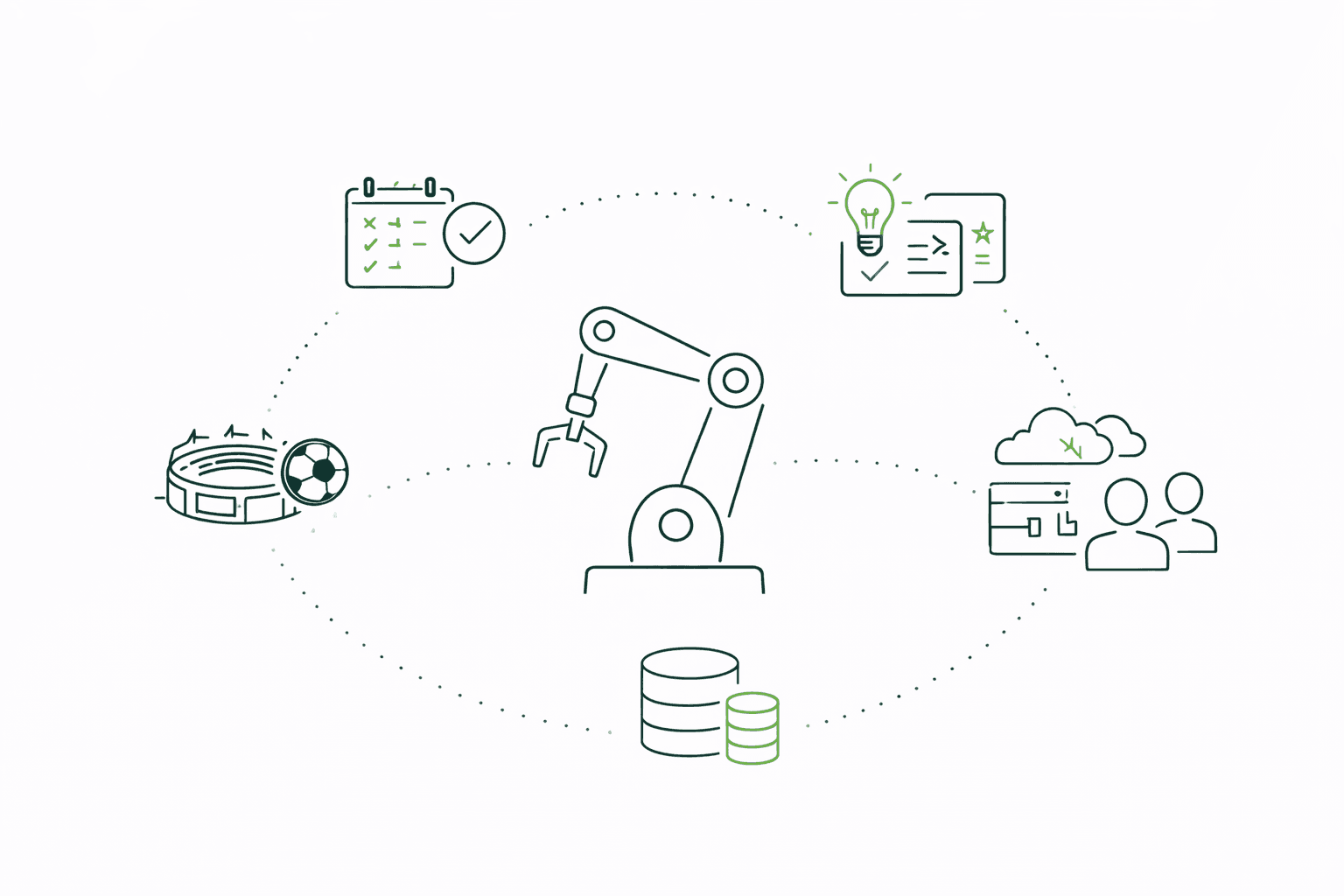
In our experience, organisations get the most traction when automation is treated as a business capability, not a technology rollout. The work typically spans a few connected streams:
Workflow and operating model assessment
Identify the “high-friction” processes that create cost, delay, or risk — and prioritise what matters.Automation planning and roadmap
Define what to automate first, what data is needed, and how success is measured (so automation stays tied to outcomes).Digital ecosystem and integration design
Reduce fragmentation by designing clean data and workflow movement between systems — without overbuilding.Data and insight enablement
Ensure automated processes produce reliable data that teams can actually use for decisions and improvements.Intelligent automation and AI (when the foundations are ready)
Apply AI where it genuinely helps: triage, forecasting, anomaly detection, decision support — not as a substitute for weak process.
This approach keeps automation practical while reinforcing a broader transformation agenda.
4.
Where organisations focus and where FFP supports
In our experience, organisations get the most traction when automation is treated as a business capability, not a technology rollout. The work typically spans a few connected streams:
Workflow and operating model assessment
Identify the “high-friction” processes that create cost, delay, or risk — and prioritise what matters.Automation planning and roadmap
Define what to automate first, what data is needed, and how success is measured (so automation stays tied to outcomes).Digital ecosystem and integration design
Reduce fragmentation by designing clean data and workflow movement between systems — without overbuilding.Data and insight enablement
Ensure automated processes produce reliable data that teams can actually use for decisions and improvements.Intelligent automation and AI (when the foundations are ready)
Apply AI where it genuinely helps: triage, forecasting, anomaly detection, decision support — not as a substitute for weak process.
This approach keeps automation practical while reinforcing a broader transformation agenda.
5.
Conclusion
Automation is transforming sports operations when it reduces friction in the day-to-day and creates the structure needed to scale. The best results come from a grounded approach: map real workflows, prioritise what matters, automate in increments, and use that discipline to strengthen platforms, data, and governance.
If you’re exploring this space and want a practical starting point, get in touch — we can share an automation planning template and talk through where the highest-impact opportunities typically sit in sports and live entertainment operations.
5.
Conclusion
Automation is transforming sports operations when it reduces friction in the day-to-day and creates the structure needed to scale. The best results come from a grounded approach: map real workflows, prioritise what matters, automate in increments, and use that discipline to strengthen platforms, data, and governance.
If you’re exploring this space and want a practical starting point, get in touch — we can share an automation planning template and talk through where the highest-impact opportunities typically sit in sports and live entertainment operations.
6.
6.
7.
7.
Discover Our
Latest
Blog.

Chat With
Us
Connect with our team instantly to discuss your project needs.
Connect with our team instantly to discuss your project needs.
You're in good company.